Your chimney is one of the most exposed parts of your property, making it highly vulnerable to weather damage.
Protect your property, preserve its character, and ensure safety with specialist chimney restoration and leadwork.
If you look up while walking along The Parade or through the residential streets of Milverton, you will notice that the skyline of Royal Leamington Spa is defined by its historic stacks. From the intricate features of Regency townhouses to the sturdy brickwork of Victorian terraces, these structures are architectural masterpieces that often require specialist chimney repairs to remain safe and watertight.
However, they are also the most exposed part of your home.
Sitting high above the roofline, your chimney endures the full force of the British weather—freezing temperatures in winter, baking sun in summer, and driving rain year-round. Because they are often out of sight, damage frequently goes unnoticed until it becomes a critical issue, resulting in damp bedroom walls or loose masonry falling into the garden.
At Trident Roofing & Building Ltd, we specialize in the specific care required for Leamington’s historic and modern chimneys. We understand that you cannot simply patch a 150-year-old stack with modern cement without causing long-term damage. We combine traditional craftsmanship with modern safety standards to keep your chimney stable, dry, and looking its best.
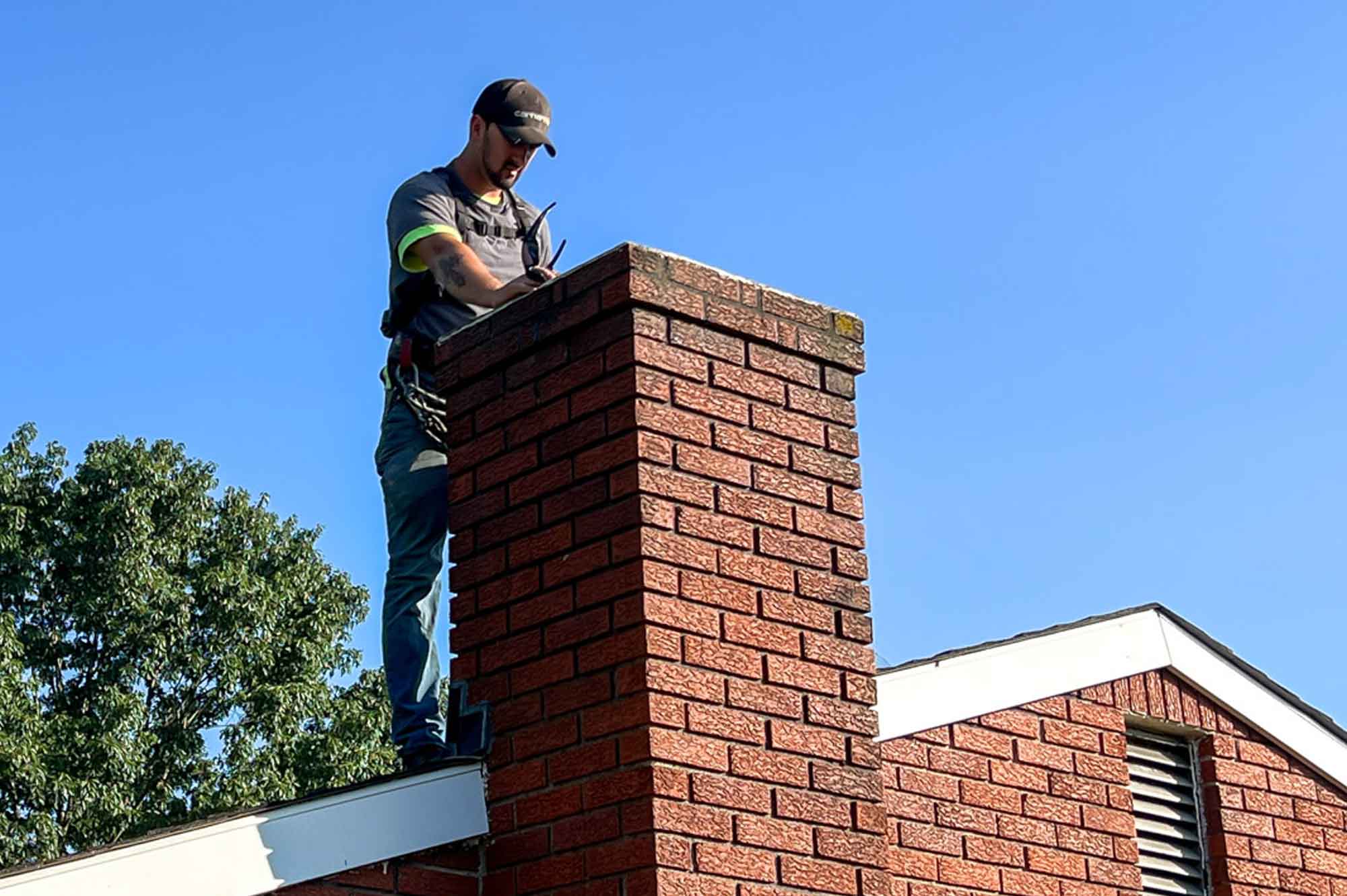
You rarely climb up to inspect your chimney, so how do you know if it needs attention? Often, your house will give you subtle clues before a major failure occurs.
Internal Warning Signs:
Damp Patches on the Chimney Breast: If you notice staining, bubbling paint, or peeling wallpaper on the wall where the chimney runs (particularly in the loft or upper bedrooms), water is penetrating the stack.
Debris in the Fireplace: Finding bits of red dust, mortar, or soot in your hearth suggests the inside of the flue is degrading.
A “Musty” Smell: A persistent damp odour near the fireplace, even when not in use, indicates moisture saturation.
External Warning Signs:
The “Grit” Test: If you find sandy granules or chunks of mortar on your patio, driveway, or in your gutters, the pointing on the stack is washing away.
Leaning Pots: If the clay pots on top look uneven or jaunty, the “flaunching” (the concrete cap holding them) has cracked.
Spalling Bricks: This is when the face of the brick crumbles or pops off. It is common in Leamington’s older properties where soft red bricks were used.
Vegetation: Seeing grass or small ferns growing from the brickwork looks quaint, but the roots are actively jacking the bricks apart.
Safety Warning: If you suspect your chimney is leaning or structurally unstable, do not wait. High winds can dislodge loose masonry, posing a risk to people and property below. Call us for an urgent safety assessment.
To understand the chimney repair, it helps to know the anatomy of the problem. Local properties face specific challenges due to the materials used during the town’s expansion in the 19th and 20th centuries.
1. The Flaunching Failure
The “flaunching” is the mortar or concrete cap on top of the stack that holds the pots in place and sheds rainwater. Over decades, this cap cracks. Once water gets into these cracks, it freezes and expands, blowing the cap apart and leaving the core of the chimney open to the rain.
2. The “Soft Brick” Issue
Many Victorian homes in North Leamington were built using relatively soft, locally sourced clay bricks. These are porous. If they are repointed incorrectly with hard cement, moisture gets trapped inside the brick. When it freezes, the face of the brick shears off (spalling).
3. Lead Flashing Decay
Where the chimney meets the roof tiles, a lead “apron” or flashing creates a watertight seal. This is the most common entry point for leaks. If the lead splits due to age or slips out of the mortar joint, water will pour directly into your roof space.
We offer a comprehensive range of services, from minor maintenance to full structural rebuilds.
This is our most requested service, but it requires expertise.
The Wrong Way: Many general builders use standard cement. This is too hard for old bricks and causes them to crumble.
The Trident Way: For pre-1930s homes in Leamington, we use Lime Mortar. Lime is flexible and breathable. It allows moisture to evaporate naturally, preserving your historic masonry. We can even colour-match the mortar to blend with the original aesthetic.
If your chimney pots are loose, we strip away the old, cracked cap. We install a new, reinforced flaunching mix that is waterproof and durable, securing the pots firmly in place. We can also replace damaged or missing clay pots with matching styles.
We are skilled lead workers. We fabricate and install:
Step Flashing: Individual pieces of lead cut into the mortar courses to follow the slope of the roof.
Front Aprons & Back Gutters: Essential for diverting water around the stack.
Soakers: Hidden flashings that sit between slates for invisible waterproofing.
Note: We never use “Flashband” (sticky tape) for permanent repairs. We use Code 4 or Code 5 milled lead.
Jackdaws and other birds love nesting in Leamington chimneys. This blocks the flue and can cause dangerous gas buildup or damp. We install:
Bird Guards: Mesh cowls that stop pests entering.
Capping Cowls: For unused fireplaces (stops rain while allowing air flow).
Anti-Downdraught Cowls: To stop smoke blowing back into your living room.
If a chimney is unused and causing constant maintenance headaches, some homeowners choose to remove it. We can carefully take the stack down to below the roofline, timber over the gap, and tile it to match the existing roof. Please read the section below on planning rules.
Royal Leamington Spa has strictly enforced Conservation Areas. If you live in the town centre, near Jephson Gardens, or in Milverton, the local authority is very protective of the street scene.
Can I remove my chimney? In a Conservation Area, the answer is often no. Even if you don’t use the fireplace, the chimney is considered a key part of the property’s character. Removing it usually requires planning permission, which is rarely granted if it changes the look of the street.
Can I change the appearance? Repairs must typically be “like-for-like.” You cannot replace a red brick stack with blue engineering brick, or render over detailed brickwork.
We Handle Compliance: We are experienced in working within these constraints. We source reclaimed bricks and pots to ensure your repair is indistinguishable from the original, keeping the Conservation Officers happy and your home beautiful.
Chimney work almost always requires working at height. We take safety seriously.
Site Assessment: We inspect the stack (often using drone technology or long ladders) to determine the extent of the damage without risking injury.
Scaffolding: For most chimney work, a scaffold tower is legally required. It provides a stable platform for our masons to work and ensures no debris falls on you or the public.
Dust Control: Grinding out old mortar creates dust. We use vacuum-assisted tools and cover your roof and skylights to prevent mess.
The Repair: Whether it’s repointing or leadwork, we execute the job using premium materials.
Final Check: We clean the gutters before leaving to ensure no mortar debris causes blockages.
Q: Do I need scaffolding for a chimney repair? A: In most cases, yes. Chimneys are the highest and most exposed point of the roof. Working from a ladder is dangerous and prevents high-quality workmanship. We include scaffolding costs clearly in your quote.
Q: My chimney is leaking; is it the brickwork or the lead? A: It could be both, but lead flashing is the usual suspect. If the lead has split or slipped, water bypasses the tiles. However, porous bricks can also soak up water like a sponge. We check both during our inspection.
Q: What is the Party Wall Act? A: If you live in a terraced or semi-detached house, your chimney might be a “Party Structure” shared with a neighbour. If we need to do structural work, you may need to inform them. We can advise you on this process.
Q: How long does repointing last? A: A professional repointing job using the correct mortar mix should last 30–50 years.
Q: Can you just seal the bricks with water repellent? A: We generally advise against simply sealing old bricks with silicone sprays, as this can trap moisture inside and cause frost damage. Proper repointing is the only long-term solution.
Don’t let a crumbling chimney threaten your roof or your safety. Call the experts who understand Leamington’s architecture.
Trident Roofing & Building Ltd – Restoring Leamington’s skyline, one brick at a time.
Call us today on +44 7733 716285 for a free chimney assessment.
Let us help you! We are experts at roofing services, and we offer a full range of repair and upkeep services.
WhatsApp us